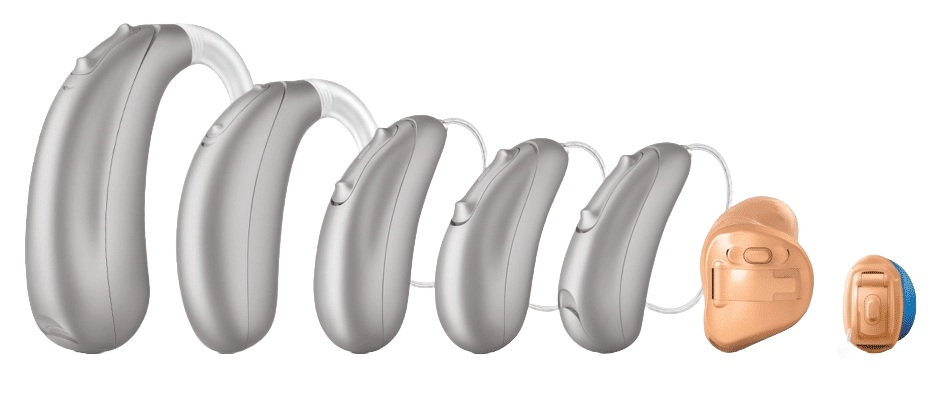
- Speech quality: Many hearing aid users are not satisfied with the quality of speech after receiving their hearing aids, although a large percentage of this dissatisfaction is due to extensive damage to the auditory nerve, which in some cases cannot be corrected. However, in other cases, hearing aids that focus more on amplifying speech and amplify background sounds less provide better speech quality.
- User voice quality: One of the most advanced technologies in hearing aids, recently introduced in hearing aids, is the ability to make the hearing aid user hear their own voice more naturally..
- Ability to communicate with phones and mobile phones: Hearing aids differ based on the quality of sound received by phones and mobile phones, and the higher their technology, the better the quality of sound received via phone.
- Ability to communicate with audio devices: Another problem for hearing aid users is hearing the sound of the television and other audio devices clearly, and even hearing the teacher’s voice more clearly in the classroom. The higher the hearing aid technology, the easier it is to achieve this.
- Remote adjustment capability: Another feature that has recently been incorporated into hearing aids is the ability to adjust hearing aids remotely via the Internet, which can solve the travel-related problems of many hearing aid users.
- Tinnitus reduction circuit: Tinnitus is one of the problems associated with hearing loss. Therefore, many advanced hearing aids have special tinnitus reduction circuits that can be very helpful in solving the problem of these patients. The price of hearing aids for tinnitus is slightly higher than hearing aids that do not have a tinnitus reduction circuit in their processing system.
Level 1
Essential level
This model features essential functionality with manual programs designed to help improve your hearing. These hearing aids are optimized for binaural (dual-ear) hearing, providing higher quality sound. In single-ear mode, they have limited adaptability to different listening environments. In this model, the precision of the hearing aid increases based on the number of channels and frequency bands.
Level 2
Medium level
This model comes with an upgraded processor for improved speed and quality. With dual microphones, these hearing aids deliver clearer speech from the front, back, and surrounding areas, enhancing overall sound quality. The precision of the hearing aid's performance increases with the number of channels and frequency bands. Additionally, these hearing aids are equipped with a noise reduction circuit.
Level 3
High level
Building on all the features of the Level 2 models, this advanced model has the highest-grade processor for superior performance. It can recognize and separately process speech sounds, offering an unparalleled hearing experience. The precision improves with the number of channels and frequency bands. These hearing aids also come with an advanced noise reduction circuit.
| Comparison among 3 main levels | |||
|---|---|---|---|
| Features | Premium | Advanced | Basic |
| Channels | 16-20 | 6-12 | 4-6 |
| Adaptive directionality of microphones | ✓ | ✓ | |
| Whistling noise remover | ✓ | ✓ | ✓ |
| Telecoil | ✓ | ✓ | ✓ |
| Programs | 4-7 | 4 | 4 |
| In situ audiometry (easy assessment of hearing) | ✓ | ✓ | ✓ |
| Environmental classifier (detection of environment type) | ✓ | ✓ | |
| Wireless fitting | ✓ | ✓ | |
| Gradual gain application for better adaptation | ✓ | ✓ | |
| Sound producing for healing tinnitus | ✓ | ✓ | |
| Noise reduction | ✓ | ✓ | |
| Direct audio streaming | ✓ | ✓ | |
| Sound adjusting in ears for better phone call | ✓ | ✓ | |
| Wireless connection between instruments | ✓ | ✓ | |
| Rechargeability | ✓ | ✓ | |
| Wind noise remover | ✓ | ✓ | |
| Natural directionality | ✓ | ✓ | |
| Frequency shift for more hearing coverage | ✓ | ||
| History of hearing aid usage in different environments | ✓ | ||
| Conversation in noise | ✓ | ||
| Conversation in crowd | ✓ | ||
| Dynamic noise reduction | ✓ | ||
| Music mode (better function in music hearing) | ✓ | ||
| Noise mode (better function in noisy environments) | ✓ | ||
UHIS Shop is proudly powered by WordPress